Near-riot at the shoe-store counter
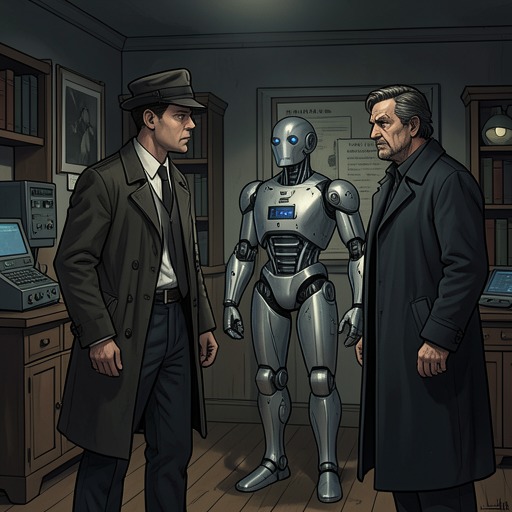
The Caves of SteelThe near-riot at the shoe-store counter turns a gathering outside a neighborhood retail department into a fast-moving confrontation over authority, public order, and the place of robots in city life. The crowd’s arrival threatens to convert accumulated frustration into violence, but the crisis ends without the destruction Baley has seen in other riots: R. Daneel’s intervention stops the advance, and the people disperse before a squad car arrives.
Causes and Setting
At East 182nd Street, near the elevator banks serving Baley’s apartment layers, a knot of people gathers outside the brilliantly lit force door of a retail department. Baley is about to direct R. Daneel onward when the gathering interrupts their journey. His question about what is happening gets no useful answer from the nearest onlooker, who has just arrived himself. The scene begins not with a clear grievance explained to the officers, but with a crowd assembling around a dispute already under way.
The wider atmosphere makes the gathering dangerous. The government calls the social disruption caused by declassification a period of growing pains and promises a better life after adjustment; meanwhile, the Medievalist movement expands as people grow desperate. The narrative stresses how quickly bitter frustration can cross into destructive action. At the store, that larger instability presses into an ordinary commercial space, where a disagreement over city-assigned clerks becomes the immediate point of confrontation.
The Store and the Escalation
The store is emptier than the street because its manager has lowered the force door early, keeping potential troublemakers outside. The barrier also prevents the people involved in the argument from leaving. Baley enters using his officer’s neutralizer and finds R. Daneel following him, putting away a smaller, neater neutralizer of his own. The manager immediately appeals to the officers, insisting that the clerks have been assigned to him by the City and that he is acting within his rights and under orders.
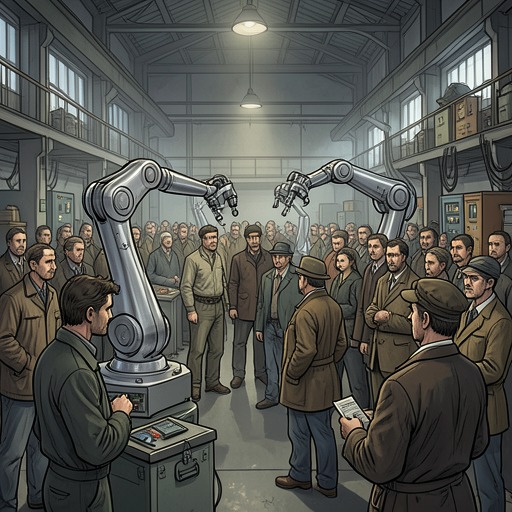
The barrier eventually goes down, and men and women crowd into the store with a roar that signals their sense of victory. That moment converts the gathering into an imminent threat. Baley remembers other riots in which crowds have destroyed robots and then turned on anything else they could dismantle. Here, the possibility of violence is heightened by the crowd’s sudden entry, but the remembered pattern does not become the outcome of this incident.
R. Daneel’s Intervention
As the manager cries out for the officers to stop the crowd, R. Daneel takes command. His voice rises to a level beyond an ordinary human voice, and he declares that the next person who moves will be shot. A voice from the back urges the crowd to get him, but for a moment nobody moves. The command interrupts the crowd’s momentum at the point when it might have become an attack.
Baley’s response gives the intervention a second significance. He recognizes that he could have called for a squad car at the outset, but instead let R. Daneel take responsibility and felt relief. He tries to explain the choice by telling himself that R. Daneel’s personality simply dominated the situation; the explanation then turns into self-reproach at the thought of a robot dominating. The episode thus puts practical authority and Baley’s unease about that authority side by side: R. Daneel’s actions resolve the crisis, while Baley struggles with what that resolution means.
Resolution and Significance
The crowd disperses. The manager calms down, adjusts his twisted jacket, smooths his hair, and mutters threats at the people leaving. Only then does a squad car’s fading whistle come to a halt outside. Baley’s bitter recognition that it has arrived after the danger has passed underscores the contrast between the delayed institutional response and R. Daneel’s immediate control of the scene.
The episode ends without the mass destruction Baley recalls from earlier riots, but it does not erase the social pressures that brought the crowd to the door. Instead, it shows how quickly a neighborhood dispute can become a test of public authority—and how a robot can be the figure capable of stopping that escalation. The near-riot is both contained and revealing: the danger recedes, while the uncomfortable question of who commands order in the city remains with Baley.